Novelist John Warner recently explains how he positions his professorial stance always "under constant renovation." There, Warner argues that effective professors in a critical, liberatory learning space is a stage of learning, to awareness and even embrace of personal responsibility. This is a stage where children (and adolescents) can leave their protected and authoritarian spaces -- such as families, churches, and schools -- but into the wild world.
If we believe that we're in a democracy (and that's arguable), then community college is brave bridge between the community into the college, and then back from the college back to the community. But whereas the community is conservative, perhaps even regressive, the ideal of college expects us to challenge each other and ultimately challenge ourselves as learners and citizens.
This is dangerous stuff, though, isn't it? And we don't like to be challenged. We don't like to be uncomfortable. We prefer to stay safe, warm, conservative. But we can't do that.

The purpose of college is not to repeat the world, but to invent the world. We have the advantage in the community college to have more expertise locally than many students from afar to their distance universities -- they know neither the local community, nor really know the national and global powers. So, in community college, we can start with our expertise, explore the known community, and bridge back our experiences to the community. We are uncomfortable, because we are already comfortable.
West, Cornel. “The Impossible Will Take a Little While.” In P. Rogat (Ed.), The Impossible Will Take a Kittle While: A Citizen’s Guide to Hope in a Time of Fear. New York: Basic Books, 2004.
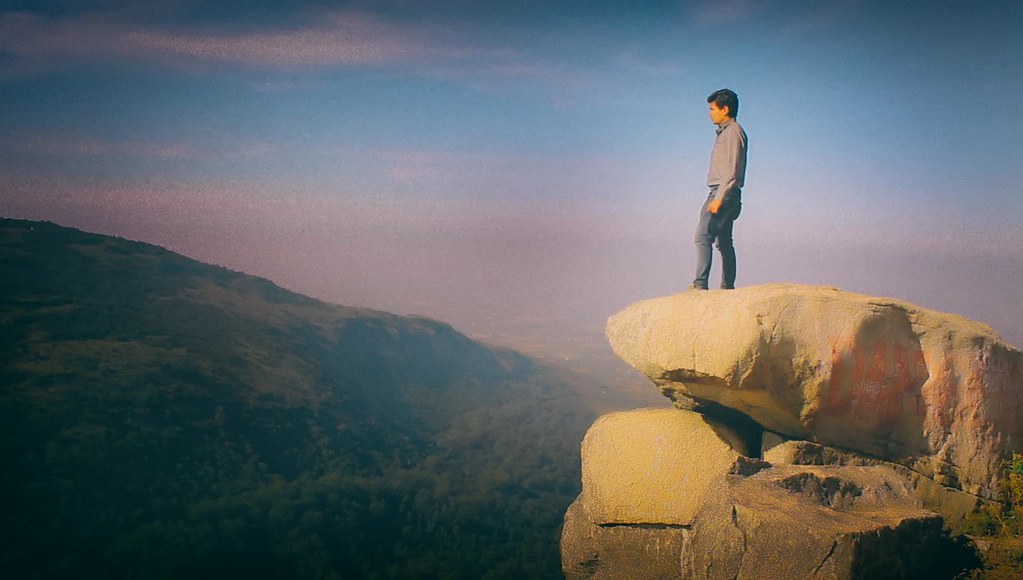 |
| Maji, Abhishek. "Standing on the Edge of the Cliff." Flickr. 28 Nov 2014. Image. |
If we believe that we're in a democracy (and that's arguable), then community college is brave bridge between the community into the college, and then back from the college back to the community. But whereas the community is conservative, perhaps even regressive, the ideal of college expects us to challenge each other and ultimately challenge ourselves as learners and citizens.
This is dangerous stuff, though, isn't it? And we don't like to be challenged. We don't like to be uncomfortable. We prefer to stay safe, warm, conservative. But we can't do that.
- As adults, we know that we are strong after being uncomfortable -- that first date, that first dance, that first play on the sport field, and especially the step of going to college. We are strong because being uncomfortable strengthens our brain and navigate society
- As scholars, we must be uncomfortable, and even in the thrill of uncomfortable place, because this is the only advance of knowledge and society
- And as community citizens, we must be uncomfortable, because we know, in our hearts, that something is not quite "right" in our communities. And the college -- when we embrace being uncomfortable -- we can bring new ideas and new histories and new writing to our community.
Scholar Cornel West argues that, as a professor, he believes students are better when they are uncomfortable:

The purpose of college is not to repeat the world, but to invent the world. We have the advantage in the community college to have more expertise locally than many students from afar to their distance universities -- they know neither the local community, nor really know the national and global powers. So, in community college, we can start with our expertise, explore the known community, and bridge back our experiences to the community. We are uncomfortable, because we are already comfortable.
Student Learning Involvement
- Write a reflection about the first week of college is uncomfortable, and writing how you can bridge that feeling with resources -- new friends, new campus support resources, and looking for opportunities for more change. Expect being uncomfortable, and living it the presence.
- Review the syllabus of your courses, and look for opportunities to be uncomfortable, and embrace that feeling. Then, if you are not yet uncomfortable with the course, communicate with your professor for more challenge.
Professor Learning Involvement
- I return to both Freire and Vygotsky. Freire calls us to bring the students' knowledge into the classroom. In short, we should ourselves expect to be uncomfortable with these students' lives. Vygotskey's theory of scaffolding would be useful to help students being both uncomfortable and comfortable in the zone.
- We should always ourselves uncomfortable in our discipline. If we "finished" education 10 years ago, then we need to be in the game again -- conferences, journals, on-line forums, and college learning communities to be consistently uncomfortable with new, multicultural, and challenged.
Resources
Warner, John. "I Want to Make Students Uncomfortable." Insider Higher Ed. 21 August 2016. Web. 26 August 2016. <https://www.insidehighered.com/blogs/just-visiting/i-want-make-students-uncomfortable>West, Cornel. “The Impossible Will Take a Little While.” In P. Rogat (Ed.), The Impossible Will Take a Kittle While: A Citizen’s Guide to Hope in a Time of Fear. New York: Basic Books, 2004.
Comments
Post a Comment